

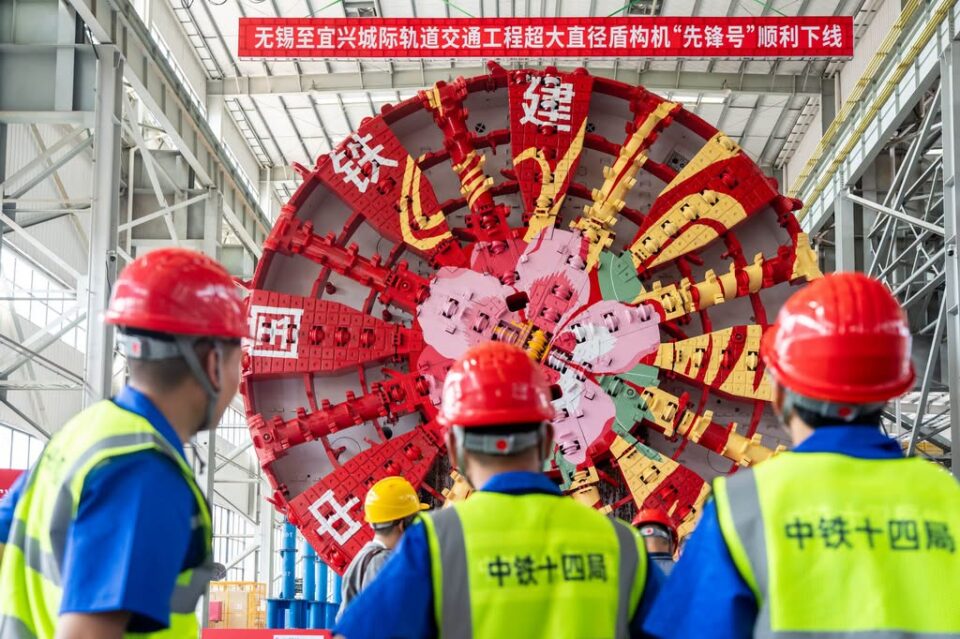
Africa’s growing demand for safer, faster and more efficient underground construction is accelerating the adoption of advanced tunnelling technologies. As governments and private investors expand mining, transport and utility infrastructure across the continent, mechanised excavation is emerging as a key engineering solution capable of delivering higher productivity, improved safety and greater construction precision.
China Railway Construction Heavy Industry Corporation (CRCHI) has taken another step in this direction with the deployment of a Tunnel Boring Machine (TBM) at the Chambishi Southeast Orebody Project in Zambia. According to the company, the machine is the first Chinese-built mining TBM to be exported to Africa, representing an important milestone in the continent’s transition towards modern underground construction technologies.
Officially commissioned in May 2026, the TBM will excavate a 9.7-kilometre underground tunnel through complex hard rock formations characterised by fault zones and elevated underground temperatures. Designed specifically for the project, the machine features an excavation diameter of 5.63 metres, measures approximately 130 metres in length and weighs around 800 tonnes.
Unlike conventional drill-and-blast methods, the TBM enables continuous mechanised excavation while simultaneously installing tunnel support, improving construction efficiency and producing a smoother, more consistent tunnel profile. The approach also minimises overbreak, reduces material waste and enhances overall project quality.
The machine incorporates several advanced engineering features to improve performance in confined underground environments, including a modular design, a trackless backup system and the ability to navigate tight turning radii and steep gradients. Additional technologies such as geological prediction systems, real-time cutter monitoring, auxiliary grippers and customised cooling systems have been integrated to improve operational reliability and support safe working conditions in challenging underground environments.
Mechanised tunnelling also delivers significant health and safety benefits by reducing the number of personnel required at the excavation face and limiting exposure to high-risk blasting activities. These advantages are becoming increasingly important as infrastructure developers across Africa seek safer, more sustainable construction methods for underground projects.
Although deployed at a mining operation, the engineering principles behind TBM technology have far wider applications across the construction and infrastructure sectors. Tunnel boring machines are widely used for metro rail systems, road tunnels, water transfer schemes, sewer networks, hydropower developments and utility infrastructure—areas expected to see significant investment across Africa and the Middle East over the coming years.
The Chambishi Southeast Orebody Project also forms part of Africa’s first digital mining development, demonstrating how automation, intelligent equipment and digital engineering are reshaping large-scale infrastructure construction. As mechanised tunnelling technologies continue to evolve, they are expected to play an increasingly important role in delivering safer, faster and more cost-effective underground infrastructure projects throughout the region.
Categories: Engineering, Technology
#Hashtags:
#Construction #Infrastructure #Engineering #TunnelBoringMachine #TBM #UndergroundConstruction #ConstructionTechnology #DigitalEngineering #SmartInfrastructure #CivilEngineering #AfricaInfrastructure #Zambia #Technology #ProjectDevelopment #MiddleEastAfrica
