

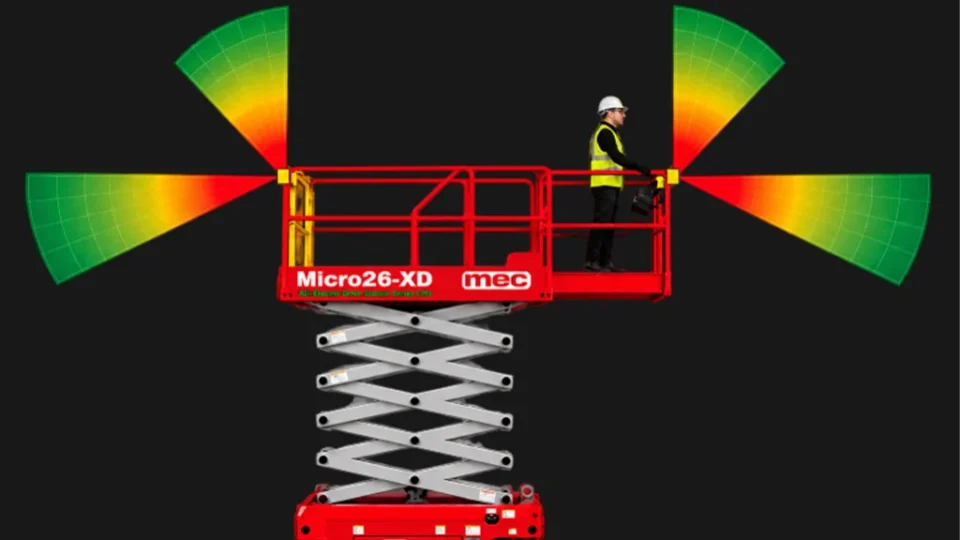
MEC Aerial Work Platforms has introduced its new Lookout Sensing System, an advancement in obstacle-detection technology designed to reduce collision risks when operating slab scissor lifts. The system combines front and rear obstacle detection during driving operations with overhead sensing during lifting, helping protect operators, nearby workers, equipment and building infrastructure.
Scissor lifts are frequently operated in confined spaces where walls, structural elements and expensive installed equipment can present collision hazards. This is particularly relevant on construction sites such as data centres, where sensitive infrastructure requires additional protection.
To manage these risks, some facility owners and safety managers have introduced measures such as additional spotters, protective bumpers and restrictions on driving lifts while platforms are elevated. While these precautions help prevent damage, they can increase labour and material costs and affect construction productivity.
The Lookout system uses four ultrasonic sensors positioned at the front and rear of the platform to detect obstacles in the machine’s direction of travel and overhead during lifting operations. When an obstacle is detected, the system progressively alerts the operator, reduces machine speed and stops movement at a predetermined distance, allowing time to respond before contact occurs.
According to Corey Raymo, Director of Aerial Work Platform Products at MEC, the system provides contractors and facility owners with an additional safety measure while helping maintain productivity on sites where valuable equipment and infrastructure must be protected.
The technology builds on MEC’s award-winning Proactive Platform Safety System and uses established ultrasonic sensing technology designed to operate without adding complexity to the operator’s controls.
Lookout incorporates a series of safety responses to help minimise collision risks while maintaining operator control. An audible warning alerts the operator when an obstacle enters the sensing zone, followed by automatic speed reduction as the machine approaches the object. If the lift continues towards the obstacle, the system stops movement at a preset distance.
For tasks requiring closer positioning, operators can override the stop function and manoeuvre the machine at creep speed. Technicians can also configure the system to operate in either warn/slow/stop or warn/slow mode, allowing the settings to accommodate specific site conditions and operational requirements.
Through the introduction of Lookout, MEC aims to provide an additional layer of collision protection for slab scissor lift operations, helping contractors manage workplace hazards while reducing the risk of damage to surrounding infrastructure.
